András Lányi and the Problem of Human-Scale Politics
Marton Trencseni - Sat 02 May 2026 - Philosophy
Introduction
András Lányi is a Hungarian writer, philosopher, public intellectual, retired university instructor, and one of the important figures of Hungarian ecological political thought. He founded the Master’s Department of Human Ecology at ELTE’s Faculty of Social Sciences, where he has taught ecology and political ecology.
His essay Menekülés a győztesek táborából — roughly, Flight from the Camp of the Victors — is not a standard green politics essay. It is not mainly about emissions targets, renewable energy, recycling, ESG, biodiversity, or the usual vocabulary of contemporary environmentalism. Its real target is deeper: the political, moral, and civilizational order that makes ecological destruction appear useful, rational, and even inevitable.
“Ecological criticism is at least as well suited to conceal as to disclose the real connections underlying the crisis of late modern industrial societies. It is as though we had to contend merely with something else altogether, with some regrettable malfunction in the Earth’s ecosystem, rather than with the suicidal striving of our own civilization. Around the world, one climate-conscious, environmentally responsible initiative follows upon another: by now, so-called environmental protection has become the cherished occupation of enterprising businessmen, vote-hunting politicians, scientific charlatans, and professional activists. By comparison, scarcely anything is said about what is to be done with the political-economic system whose operative logic presents the rapid destruction of our sources of life as useful, rational, indeed unavoidable.”
The essay asks what ecological politics would look like if it did not merely repaint liberalism, socialism, or conservatism green, but instead started from the ecological crisis as a crisis of modern civilization itself.
“Most of the literature of political ecology does not even reach questions that are “political” in the stricter sense of the word. It points to the connection between the collapse of ecosystems and the unsustainable social practices that bring about that deterioration, yet its argument remains within the conceptual frameworks through which contemporary political philosophy explains, and ultimately justifies, those very practices. In accordance with their political socialization, people declare themselves green socialists, green liberals, or green conservatives, and insist that abolishing social inequalities, or introducing the “polluter pays” principle, or returning to traditional values, or reining in the market, or indeed prohibiting market-distorting measures, or taking a firm stand against selfish nationalism or cosmopolitan corruption, will enable us to avoid catastrophe. In this way they reinforce the belief that the answer to the new challenges of the twenty-first century must be sought in the intellectual inheritance of the eighteenth and nineteenth centuries, thereby making it easier to “green” old-style political programs.”
The intellectual hinge of the essay is Simone Weil. Weil was a French philosopher, mystic, political activist, factory worker, and member of the French Resistance, whose writings were mostly published after her death in 1943. She is hard to classify: part Platonist, part Christian mystic, part anarchist, part social critic, part moral absolutist. Lányi turns to her because she saw modernity as a trap. Humanity liberated itself from direct dependence on nature, but then became dependent on vast social systems of its own making. In Lányi’s reading, this is not merely an economic problem. It is a civilizational one.
This post is not a full translation of Lányi’s essay. Instead, it first summarizes the argument in plain language, with selected translated passages to give the flavor of the essay. It then offers a set of reflections on what is powerful, unclear, and perhaps unstable in the political vision Lányi sketches. All translations are mine.
Part One: Summary of the essay
Ecological politics is too shallow
Lányi opens with a provocation: ecological criticism can conceal the crisis as much as reveal it. Environmental language often lets society pretend that it is dealing with an external “malfunction” in nature, rather than with a suicidal tendency internal to modern civilization:
“It is as though we had to contend merely with some regrettable malfunction in the Earth’s ecosystem, rather than with the suicidal striving of our own civilization.”
His complaint is that much of what passes as environmental politics leaves the operating logic of the modern political-economic system untouched. Businesses, politicians, NGOs, and academics can all speak the language of environmental responsibility while avoiding the deeper problem: modern society treats the rapid destruction of its own life-supporting conditions as a rational side effect of growth, efficiency, and progress.
“Scarcely anything is said about what is to be done with the political-economic system whose operative logic presents the rapid destruction of our sources of life as useful, rational, indeed unavoidable.”
A large part of ecological discourse remains managerial. It asks how to make the existing system cleaner, greener, more efficient, and less carbon-intensive. Lányi’s question is more radical: what if the system’s basic success criteria are already pathological? Lányi is not saying that modern society fails because it is irrational. He is saying something more disturbing: modern society may be failing because it succeeds too well at the wrong things. More production, more control, more calculation, more data, more technological mastery, and more growth are usually counted as achievements. For Lányi, these achievements may themselves be the mechanism of collapse:
“We are being destroyed by precisely those things of which we are accustomed to boast.”
That is the force of one of the essay’s most memorable lines:
“Collapse will not be the punishment for our sins, but the reward for our virtues.”
This line captures the essay’s deepest provocation. The ecological crisis is not merely the result of vice, greed, stupidity, or ignorance. It may be the consequence of capabilities and ideals that modern civilization itself treats as virtues: knowledge, growth, abundance, control, and efficiency. Lányi also makes a related point about justice:
“.. a catastrophe cannot be distributed justly.”
This is a crucial distinction: physical goods can be redistributed, taxes can be adjusted, and rights can be expanded, but ecological catastrophe destroys the shared conditions under which justice itself is supposed to operate.
Force, institutions, and the individual
The essay then moves from ecology to political philosophy. Lányi argues that human relations are governed either by coercion or by mutual understanding and goodwill. Since institutions necessarily involve coercion, the task cannot be to abolish coercion completely. That is impossible. The realistic task is to balance and neutralize it.
“The coercion must not be abolished — alas, that is impossible — but rather balanced and neutralized.”
This is where Simone Weil enters. In Lányi’s reading of Weil, capitalism freed the human collective from nature, but then the collective inherited nature’s oppressive role in relation to the individual:
“Capitalism succeeded in liberating the human collective from the bondage of nature. But in relation to the individual, the collective itself inherited the oppressive role previously played by nature.”
Nature once constrained human beings through famine, disease, exposure, and brute necessity. Modern society overcame much of that. But the individual is now constrained by institutions, markets, bureaucracies, technological systems, financial systems, and mass society. In plain terms, human beings are no longer crushed mainly by nature. They are crushed by their own machinery.

Lányi develops this point most directly when he describes how impersonal systems replace living social relations. The institutions of rational social organization — law, markets, technological systems, information networks, bureaucracy, and exchange mechanisms — no longer merely coordinate human cooperation. They begin to substitute for it.
“The impersonal coercion institutionalized in technological systems, information networks, bureaucratic procedures, and exchange rates renders the dialogue of cultures, indeed cultural dialogue itself — the foundation of social cooperation — superfluous, practically impossible.”
This point overlaps with Marx, but it is not reducible to Marx. Lányi is not only criticizing private ownership or class exploitation. He is criticizing the impersonal coercion built into modern systems as such: markets, bureaucracies, technological infrastructure, global networks, and even legal-rational institutions. Modern society does not need a tyrant in order to dominate the individual. Domination can be distributed across procedures, incentives, dashboards, prices, institutions, and systems nobody fully controls.
Lányi’s answer, via Weil, is that the only true counterweight to coercion is mutual understanding, goodwill, and what Weil calls “the radiance of the spirit”:
“Those errors and lies are dangerous because they prevent us from appealing to what lies outside violence and protects against it: that other force which is the radiance of the spirit.”
The problem of goodwill
The moral claim is clear. Force cannot generate justice from within itself. If all social life is reducible to power, then “justice” becomes only another name for whatever the stronger party can impose. A tyrant can seize property; a majority can vote away rights; a court can enforce an immoral law. Enforcement makes rules effective, but not necessarily just.
Lányi and Weil then make a further move. Since force cannot ground justice, the counterweight must be goodwill, mutual understanding, attention to others, or spiritual radiance. Goodwill exists, but it is unevenly distributed, unstable, and usually weaker than organized power. People can be generous, attentive, compassionate, and cooperative. They can also be frightened, tribal, status-conscious, exhausted, humiliated, resentful, or simply indifferent. In small groups, goodwill can matter enormously. At the scale of modern societies, it cannot be assumed.
The more defensible version of the argument is not that goodwill can defeat coercion. It is that institutions must be designed so coercive powers check one another, while preserving social spaces in which goodwill, mutual recognition, and voluntary cooperation can survive. That claim is much more plausible, and it is also closer to what liberal constitutional democracies already try to do. They do not abolish force; they divide it, constrain it, proceduralize it, slow it down, and make it contestable.
Modern democracies therefore deserve more credit than Lányi’s essay seems to give them. At their best, they enable goodwill by creating protected spaces for civil society, association, charity, public argument, local self-government, religious life, family life, and voluntary cooperation. They certainly do not guarantee goodwill, but they often make it more possible. The real enemies of goodwill may not be democracy as such. They may be capitalism, competition, bureaucracy, mass media, propaganda, status anxiety, time pressure, technocracy, and the sheer scale and anonymity of modern life.
The “coherent lie” and the “incoherent lie”
One of the essay’s most striking phrases is borrowed from Weil’s analysis of Nazism:
“With Hitler, a coherent lie triumphed over an incoherent one.”
The idea seems to be that liberal modernity claimed to stand for freedom, rights, equality, and justice, while in practice tolerating domination, exploitation, hierarchy, and impersonal coercion. This made it an “incoherent lie”: its official ideals and its social reality did not line up.
Nazism, by contrast, was also a lie, but a more coherent one. It openly embraced struggle, domination, hierarchy, myth, violence, and collective destiny. Its premises were monstrous, but its brutality was aligned with them.
The formulation is rhetorically powerful, but analytically slippery. If Nazism was more open about domination, then the lie cannot be its embrace of force, because that part is openly stated. The lie must lie elsewhere: in its racial mythology, historical fantasies, cult of destiny, promises of national rebirth, and dehumanizing account of its enemies.
Likewise, if liberal modernity is incoherent, it does not automatically follow that it is a lie. A society can be hypocritical, compromised, self-deceived, contradictory, aspirational, or morally inconsistent without being a lie in the same sense as totalitarian propaganda. The better distinction may be between a political order whose ideals and practice diverge, and another whose evil premises are more directly reflected in its practice. That is a real and important distinction, but “coherent lie versus incoherent lie” compresses too many things: falsehood, hypocrisy, contradiction, internal consistency, and moral evil.
Still, the underlying warning is worth keeping. When a society’s official ideals and actual operation diverge too much, it becomes vulnerable to a brutal rival ideology that says: stop pretending; power is all there is. That is a serious insight, even if the formula is slippery.
Decentralization and human scale
The final section of the essay argues that ecological politics must restore human scale. Lányi’s conclusion is decentralization across all areas of life. Political order should be rebuilt around local communities, self-government, and forms of life small enough for human beings to understand, influence, and sustain:
“The ecological turn in politics means above all the restoration of human scale: that is, decentralization in every sphere of life.”
This is attractive. Large systems do become alienating. Bureaucracies turn people into cases. Markets turn relationships into transactions. Technological systems turn judgment into procedure. Mass media turns public life into spectacle. Human beings are indeed better at responsibility, attention, and mutual recognition at a scale where they can still see and understand the consequences of their actions.
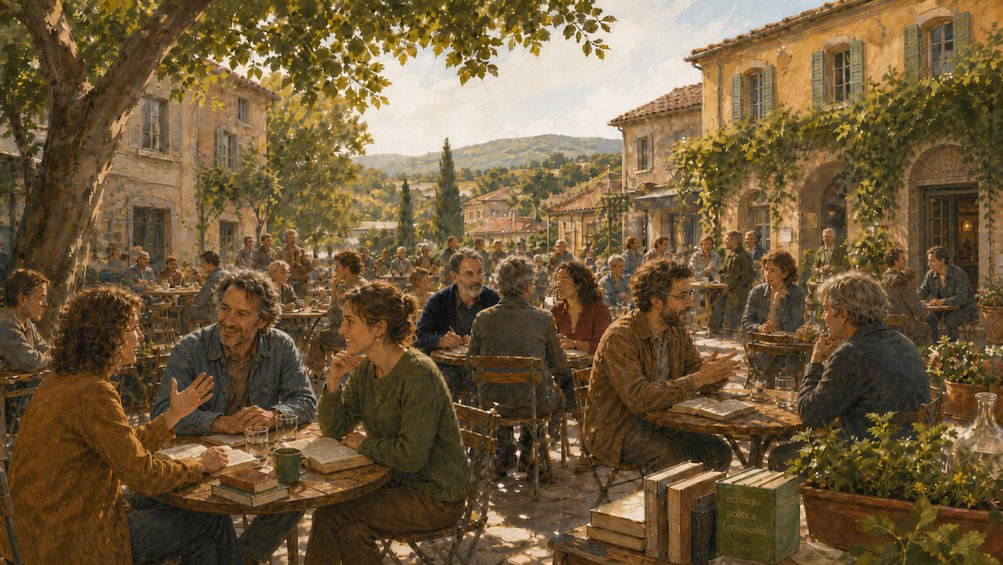
Lányi’s ideal here is dynamic equilibrium. A living political order, in his view, should resemble a self-organizing system whose balance is continually disturbed and restored. But the equilibrium is possible only when the size of the organism remains proportionate to the nature of the association:
“This dynamic equilibrium, continually disturbed and continually restored — the essence of self-organization — can be maintained only so long as the size of the organism remains proportionate to the nature of the association.”
Part Two: Reflections
The brittleness of decentralization
The most serious weakness in Lányi’s political vision is not the appeal to human scale itself. That appeal is compelling. The weakness is that decentralization appears too close to a complete answer.
Imagine an idealized country that has achieved Lányi’s decentralized order: small, self-governing, humane, cooperative communities. Then imagine that this country is attacked by a centralized, militarized, aggressive neighbor. A current example in Europe: while Ukraine’s resistance to Russia has certainly involved local courage, civic resilience, volunteer networks, and decentralized initiative, but survival has also required international assistance, centralized command, national military organization, intelligence, industrial logistics, international finance, strategic communications, air defense, artillery procurement, and large-scale alliances.
More broadly, Europe’s response to Russia has not been a turn toward localism. It has been a recognition that military and strategic coordination must deepen. European states are not concluding that the future belongs to loose localism; they are relearning the need for defense capacity, industrial depth, alliance structures, intelligence coordination, and transnational military cooperation.
Borrowing loosely from physics, Lányi’s human-scale order can be tested as a proposed equilibrium. A stable equilibrium is a state that tends to return to itself after being disturbed. An unstable equilibrium is one that may look balanced under ideal conditions, but collapses into another state when perturbed. The decentralized human-scale order may be internally attractive but externally unstable. It may work if political communities evolve in the same direction and at roughly the same pace. But if even one large neighboring power remains centralized, militarized, and aggressive, the decentralized order may face two options: recentralize for survival, or disappear.
That is not a minor exception. Defense is one of the core tests of political order. The same issue appears in other domains too. Pandemic response, energy grids, climate adaptation, monetary stability, advanced research, cyber defense, semiconductor supply chains, and large infrastructure all require coordination beyond the local. Human-scale communities may be where meaning is produced, but they are not always where survival is secured.
Democracies as stable equilibrium
Modern democracies may already be closer to a stable equilibrium than Lányi’s proposed decentralized order. They are not perfect. They are often hypocritical, slow, captured by interests, distorted by media, weakened by capitalism, and vulnerable to polarization. But historically, they have passed some very hard tests.
In the twentieth century, liberal democracies repeatedly defeated dictatorial systems: in the First World War, the Second World War, and the Cold War. They did not do so as purely local, decentralized communities. They did so by combining pluralism with state capacity; civil society with industrial mobilization; constitutionalism with military command; individual freedom with national coordination; and domestic democracy with international alliances.
That combination is important. Modern democracy is not merely majority rule. It is a layered system of conflict management and self-correction. It includes elections, courts, constitutions, rights, bureaucracies, parties, local governments, civil society, public criticism, markets, universities, professional norms, and alliances. Some of these elements check others. None is sufficient by itself. The point is the balance.
This sounds, interestingly, closer to Weil’s own equilibrium idea than to pure decentralization:
“Only equilibrium can annul force.”
That line may be the most politically useful part of the Weilian inheritance. Coercion cannot be abolished. It must be balanced. Power must not disappear; it must be divided, checked, and made answerable.
The better model may therefore not be decentralization everywhere, but subsidiarity: decisions should be made at the lowest level capable of handling them, but no lower. Local communities should govern what they can govern. Cities, regions, states, federations, and alliances should handle what only they can handle.
In other words, the political ideal may be human-scale below, constitutional democracy in the middle, and strategic coordination above. That seems more robust than radical decentralization.
Conclusion
Lányi’s essay is valuable because it asks a deeper question than most ecological politics does. It does not merely ask how emissions should be reduced, which environmental policies should be adopted, or how existing institutions can be made greener. It asks what kind of political and moral order can preserve humane life under ecological limits.
That is the right level of seriousness. Much environmental discourse remains trapped inside managerial categories: targets, incentives, reporting, investment, offsets, compliance, innovation. Those things matter, but they do not answer the civilizational question. Lányi is asking whether the modern system’s basic logic — more scale, more production, more abstraction, more control, more efficiency — is compatible with human and ecological flourishing.
Even where the proposed answer seems incomplete, the essay performs a rare and valuable task: it forces ecological politics back into contact with first principles. It asks what kind of knowledge, what kind of power, what kind of community, and what kind of human being our politics presupposes. It also reminds the reader that no institutional arrangement, however sophisticated, can substitute for a culture capable of attention, restraint, conversation, and goodwill.
A more robust answer may be layered democracy rather than decentralization alone: human-scale communities below, constitutional democratic institutions in the middle, and strategic coordination above. But that answer still owes something important to Lányi’s challenge. Without the demand for human scale, democracy becomes administration. Without conviviality, freedom becomes loneliness. Without ecological limits, progress becomes self-destruction.
For that reason, Menekülés a győztesek táborából is worth reading not only as an ecological essay, but as a serious philosophical provocation about the kind of political life that might still deserve to survive.